
what is a quantum computer?
Quantum computing is the area of study focused on developing computer technology based on the principles of quantum theory, which explains the nature and behavior of energy and matter on the quantum(atomic and subatomic) level. A quantum computer is a device that performs quantum computing. such a computer s different from binary digital electronic computers based on transistors and capacitors.They encode information as a quantum bits or qubits , which can exist in superposition.whereas common computers work on bits that exits as either 0 or 1.
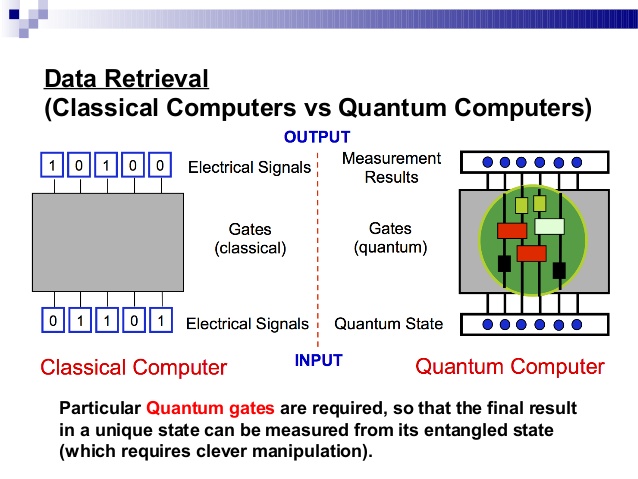
A classical computer has made up of bits, where each bit is represented by either a one or a zero. A quantum computer, on the other hand, maintains a sequence of , which can represent a one, a zero, or any quantum superposition of those two qubits state, a pair of qubits can be in any quantum superposition of 4 states and three qubits in any superposition of 8 states.In general a quantum computer with n qubits can be in an arbitrary superposition of up to 2^n different states simultaneously. This compares to a normal computer that can only be in one of these 2^n states of any one time.
How quantum computer is different from traditional computer?
Classical computers encode information in bits, which can take the value of 1 or 0. You can think of these 1 s and 0 s as the currency of on/off switches that ultimately control how a computer works. Quantum computers, on the other hand, explained Prof Lloyd, are based on ‘qubits’, which can represent both a 1 and a 0 at the same time. Entanglement means that qubits in a superposition can be correlated with each other. Harnessing these two principles, qubits can be thought of as much more sophisticated currency for information processing, enabling quantum computers to tackle difficult problems that are intractable using today’s computers.
What is remarkable is that if you add extra qubits, the process scales geometrically: a quantum computer with two qubits could run four calculations at the same time. But a 1,000-qubit device could process more simultaneous calculations than there are particles in the known universe. However, one big issue is a kind of drop-out called decoherence, where qubits lose their useful ambiguity and become humdrum 1s and 0s.

ADVANTAGES OF A QUANTUM COMPUTERS

- The main advantage of quantum computing is it can execute any task very faster when compared to the classical computer, generally the atoms changes very faster in case of the traditional computing whereas in quantum computing it changes even more faster. But all the tasks can’t be done better by quantum computing when compared to traditional computer.
- In quantum computing qubit is the conventional superposition state and so there is an advantage of exponential speedup which is resulted by handle number of calculations.
- The other advantage of quantum computing is even classical algorithm calculations are also performed easily which is similar to the classical computer.
DISADVANTAGES OF QUANTUM COMPUTERS
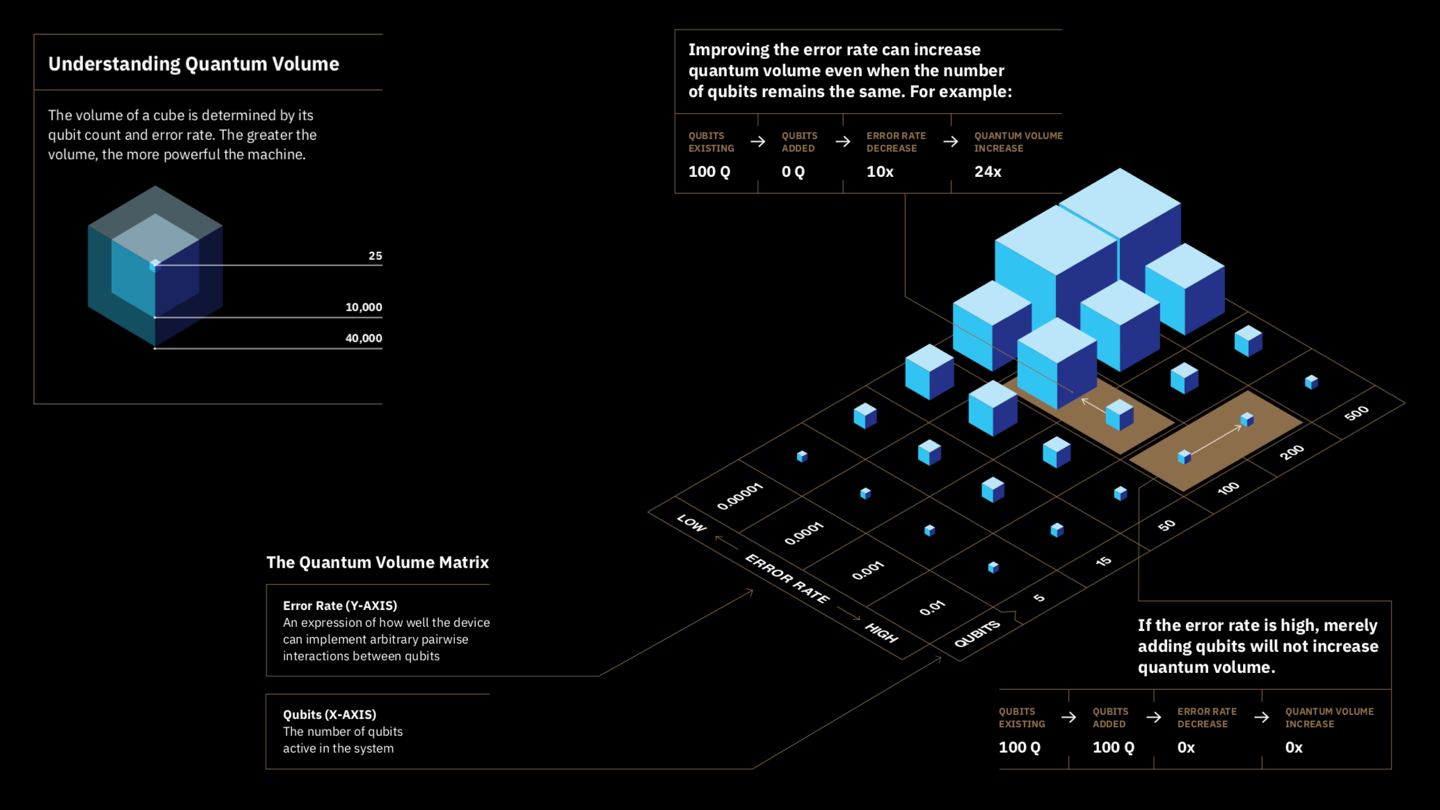
- The main disadvantage of computing is the technology required to implement a quantum computer is not available at present. The reason for this is the consistent electron is damaged as soon as it is affected by its environment and that electron is very much essential for the functioning of quantum computers.
- The research for this problem is still continuing the effort applied to identify a solution for this problem has no positive progress.
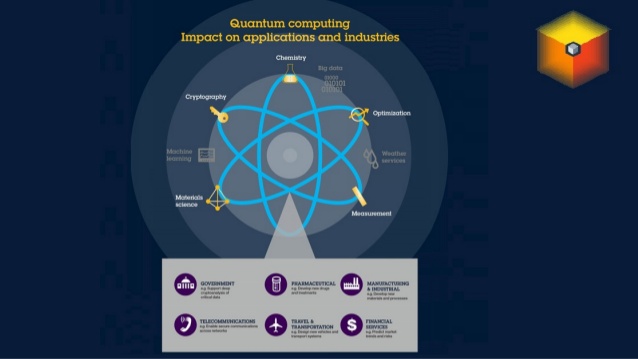
APPLICATIONS OF QUANTUM COMPUTERS
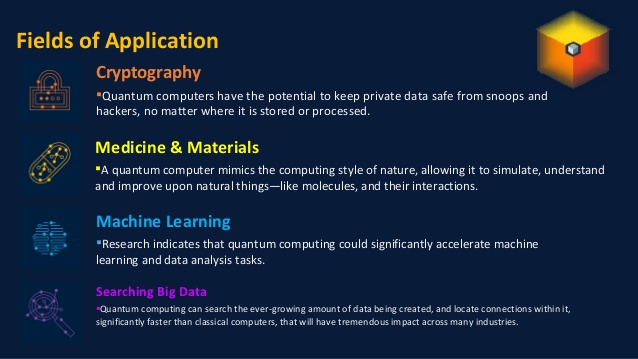
Optimation
Imagine, say, you are a traveling salesman. You wish to visit a handful of cities and want to know what the most optimal routes would be. This would be an example of an optimization problem. It sounds simple enough, but, in reality, the process can get quite involved as you up the number of variables. With only 270 destinations, for example, there are more combinations of travel than atoms in the universe.
With quantum computers, however, we could expect a machine to be able to handle almost innumerable permutations and combinations, which could advance system design and analysis in massive ways.
Conclusion

The field of quantum computing is growing rapidly as many of today’s leading computing groups, universities, colleges, and all the leading IT vendors are researching the topic. This pace is expected to increase as more research is turned into practical applications. Although practical machines lie years in the future, this formerly fanciful idea is gaining plausibility.
The current challenge is not to build a full quantum computer right away; instead to move away from the experiments in which we merely observe quantum phenomena to experiments in which we can control these phenomena. Systems in which information obeys the laws of quantum mechanics could far exceed the performance of any conventional computer. Therein lies the opportunity and the reward. No one can predict when we will build the first quantum computer; it could be this year, perhaps in the next 10 years, or centuries from now. Obviously, this mind-boggling level of computing power has enormous commercial, industrial, and scientific applications, but there are some significant technological and conceptual issue to resolve first.
But quantum computers will come.

 Quantum Computers